
“My highest recommendations for Devon and the Maritime Air team — thorough, honest, and on time. They explained everything in plain language and didn't push any unnecessary upsells.”
Spencer Fuller
May 2026
The run capacitor is the #1 HVAC failure we see on the Treasure Coast — and the easiest to misdiagnose. Here's how a 25-year tech identifies a weak capacitor before it kills your compressor, why Florida heat shortens their life, and what to do the moment your AC starts struggling.
Verified Google reviews
Class-A CAC1824400
Treasure Coast residents
Full-spectrum HVAC
Approved before work begins
Warranties registered for you
St. Lucie County member
Think of a capacitor as a battery that fires once per startup. AC compressors and condenser fan motors need a high-voltage 'kick' to overcome standing torque. The capacitor stores that energy and dumps it the instant the contactor closes. A weak capacitor delivers a weak kick, and the motor either struggles to start or doesn't start at all.
Capacitors rarely fail all at once. They drift below their rated microfarads slowly, and you'll see signs for weeks before the system stops cooling.
Visual inspection catches the obvious failures — bulged top, ruptured can, oil seepage. But a capacitor can read fine visually and still be 40% weak electrically. We use a capacitance meter to read actual microfarads against the printed rating. Anything more than 6% below spec gets replaced — manufacturers consider that the failure threshold.
Electrolytic capacitors are heat-sensitive by design. The Treasure Coast combination of 95°F summer ambient, full-day run cycles, and lightning-driven voltage transients means your capacitor lives in worst-case conditions year-round. Add a black-roof condenser pad and internal capacitor temperatures hit 180°F. Expected life drops from 10 years to 4–6.
We match the OEM microfarad and voltage rating exactly. Going 'one size up' on microfarads is a myth that damages compressors. We use 440V capacitors even on 370V applications because the higher voltage rating dramatically extends life with no downside. Brand matters — we stock AmRad and Genteq, which carry true 5-year warranties.
If we're replacing your capacitor twice in two years, the capacitor isn't the real problem. We check for: high head pressure (dirty condenser, low airflow), failing contactor causing voltage chatter, compressor windings drawing high amps, and incoming voltage drops from the utility. A capacitor is a symptom — sometimes the disease is upstream.
On older compressors or long line sets, adding a hard-start capacitor kit reduces startup amp draw and extends compressor life. We recommend it on systems 8+ years old, on rooftop installs, and any time we hear startup struggle. It's a cheap insurance policy.
“My highest recommendations for Devon and the Maritime Air team — thorough, honest, and on time. They explained everything in plain language and didn't push any unnecessary upsells.”
“Devon has provided thorough maintenance and excellent service. Truly family-owned care — they treat your home like it's their own. Highly recommend for Treasure Coast homeowners.”
“Working with Devon on my HVAC system was a great experience from start to finish. Fair, clean install, and the system has been running perfectly through Florida summer heat.”
Real installs and repairs we've completed across the Treasure Coast.
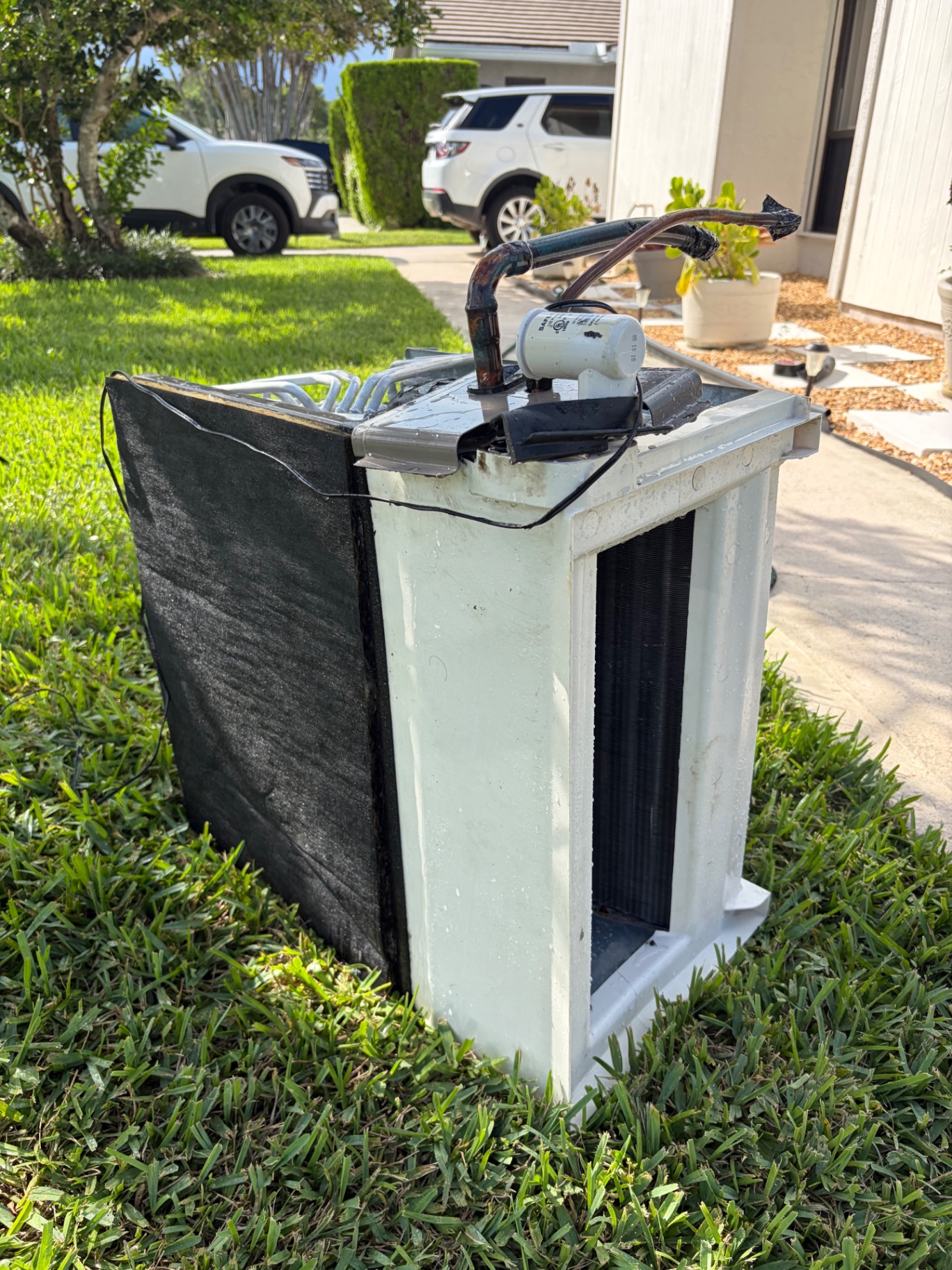
It stores and releases an electrical jolt that gets the compressor and condenser fan motor started. Without it, both motors hum but never spin up.
Most common signs: outdoor unit hums but the fan doesn't spin, AC takes several tries to start, system blows warm air, or you see the capacitor's top swollen/leaking oil when the disconnect is pulled.
Heat is the enemy. A capacitor rated for 10 years in a temperate climate often lasts 4–6 here. Run-time hours, voltage spikes from afternoon storms, and rooftop installations accelerate failure.
Capacitors store lethal voltage even after power is off. They must be discharged with an insulated tool before touching the terminals. We don't recommend DIY — but if you do, kill power at the breaker AND disconnect, then discharge across both terminals with an insulated screwdriver.
Yes. Running a compressor on a weak capacitor draws excessive amperage and overheats the windings. A $200 capacitor left too long becomes a $2,000+ compressor.
15–25 minutes once we're on site. We verify microfarad rating with a meter, match brand-spec replacement, and test amp draw on startup before leaving.
A dual (round) capacitor handles both the compressor and condenser fan in one can. Single (oval) capacitors handle one motor each — usually older systems or split designs.
Microfarad rating, voltage rating, whether it's single or dual, brand-spec OEM vs aftermarket, and whether the contactor or hard-start kit also need replacement at the same time.
Call (772) 236-4277 or schedule online. Class-A licensed across the Treasure Coast.